
 Click Here Now

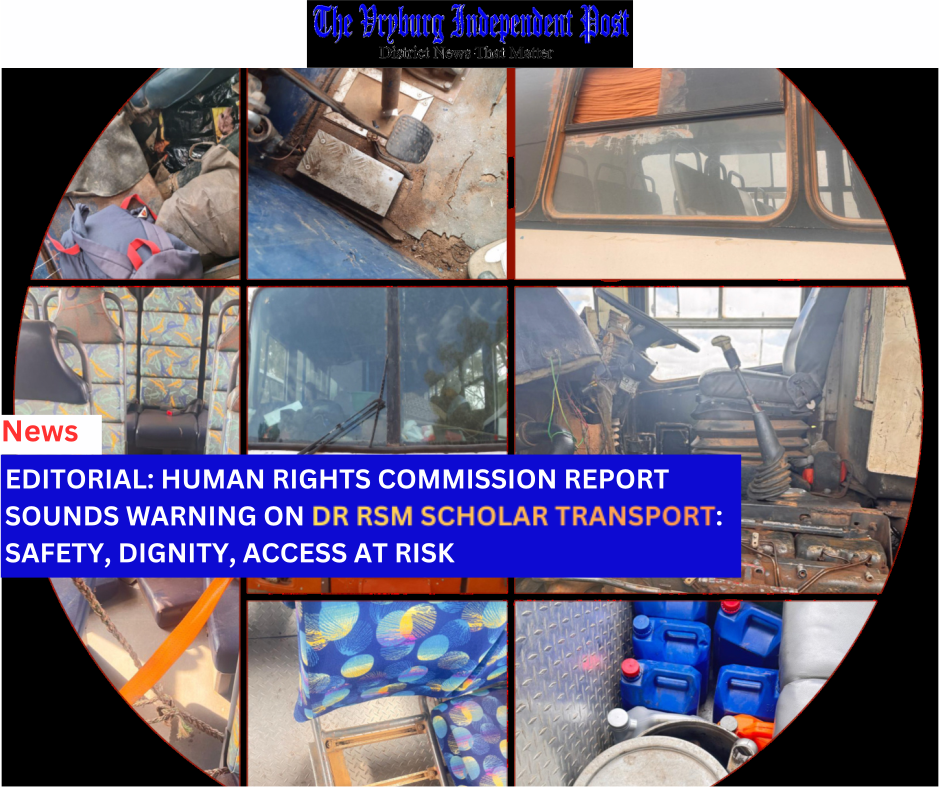
A final inquiry report by The South African Human Rights Commission (SAHRC) on scholar transport in the North West Province has raised concerns about recurring challenges affecting learners in the Dr Ruth Segomotsi Mompati (Dr RSM) District, and other districts in the province, including overcrowded buses, late drop-offs and pick-ups, and a lack of adult supervision on some routes.
The report’s “site inspections” section show that monitoring visits in September 2024 recorded challenges at several Dr RSM schools—issues that, the report suggests, have direct consequences for learner safety, punctuality and teaching time.
Schools and issues recorded during monitoring
Bopaganang Secondary School (Dr RSM District) – monitored 20 September 2024
• Overcrowding of buses, linked to transport collecting learners from different areas.
• Learners reportedly arrive late, disrupting teaching and learning.
• Transport reportedly not always available, contributing to absenteeism.
Colinda Primary School (Dr RSM District) – monitored 17 September 2024
• Scholar transport reported to be in poor condition.
• Learners reportedly delivered late and collected late.
• Overcrowding reported as a challenge.
• Primary and secondary school learners reportedly transported together.
• No supervision reported on the bus.
Colinda Secondary School (Dr RSM District) – monitored 20 September 2024
• Learners reportedly delivered late and collected late.
• Primary and secondary school learners reportedly transported together.
• No supervision reported on the bus.
Diatleng Primary School (Dr RSM District) – monitored 18 September 2024
• No supervision reported on scholar transport.
Beyond the operational problems recorded during the SAHRC site inspections, the report’s analysis section argues that the core issue is whether the state—through COSATMA, the North West Department of Education (NW DOE) and the North West Provincial Treasury/Provincial Transport function—has met its constitutional and statutory duties to ensure learners can access basic education “safely, reliably, and with dignity”.
The report says national and provincial policies position scholar transport as a joint responsibility between COSATMA and the NW DOE. However, SAHRC says it links persistent coordination failures to a 2004 Executive Council decision that assigned the learner transport function to COSATMA—an arrangement the report says has fragmented governance and diluted accountability, creating role confusion. According to the commission, “…it is apparent that the conduct of the responsible departments falls significantly short.”
According to the inquiry, this confusion was worsened by guidelines and a protocol/MOU that did not clearly express the “joint” nature of responsibility. The report notes that, early in the inquiry, the two departments attempted to shift responsibility to each other—describing the NW DOE as minimising its role to needs analysis and data provision, while COSATMA viewed itself as the lead implementing authority.
In one of its sharpest critiques, the report says policy and guideline gaps undermine the ability to deliver scholar transport in a manner consistent with section 29 of the Constitution. It highlights that policies do not set out a clear process for identifying learners who should receive transport, nor a criterion for assessing need—meaning decisions can become largely discretionary and risk excluding learners who should qualify.
The report also points to uncertainty around the policy promise that transport should be provided to the “nearest appropriate school”. It states that policies and guidelines do not define what “appropriate” means, and raises the practical question of whether a school is “appropriate” if it does not offer learning streams aligned with a learner’s abilities and career goals.
Importantly for Dr RSM, the Commission says it has taken notice of a local phenomenon: young learners leaving their parental homes for rented accommodation to be closer to schools that better match their aspirations—exposing them to “social, physical and other forms of harm”. The report states this would not be happening if such learners were provided with scholar transport.
Taken together, the inquiry’s analysis suggests that the site-inspection problems seen at Dr RSM schools—overcrowding, late arrivals and supervision gaps—should be read not only as day-to-day operational failures, but also as symptoms of deeper governance and policy weaknesses: unclear accountability between COSATMA and the NW DOE, limited policy guidance on eligibility, and gaps that can push families into risky coping strategies, including relocation closer to desired schools.
-The VIP Editor in Chief
-SAHRC
Scholar Transport Final Inquiry Report in the North West
click the above link to read the complete report ☝🏼